What Is Speed-to-Lead? (The Stat That Kills Most Facebook Ad ROI)
TL;DR — Key Takeaways:
- Speed-to-lead is the exact duration between a prospect submitting their info and your first response. It is the #1 lever in your sales funnel.
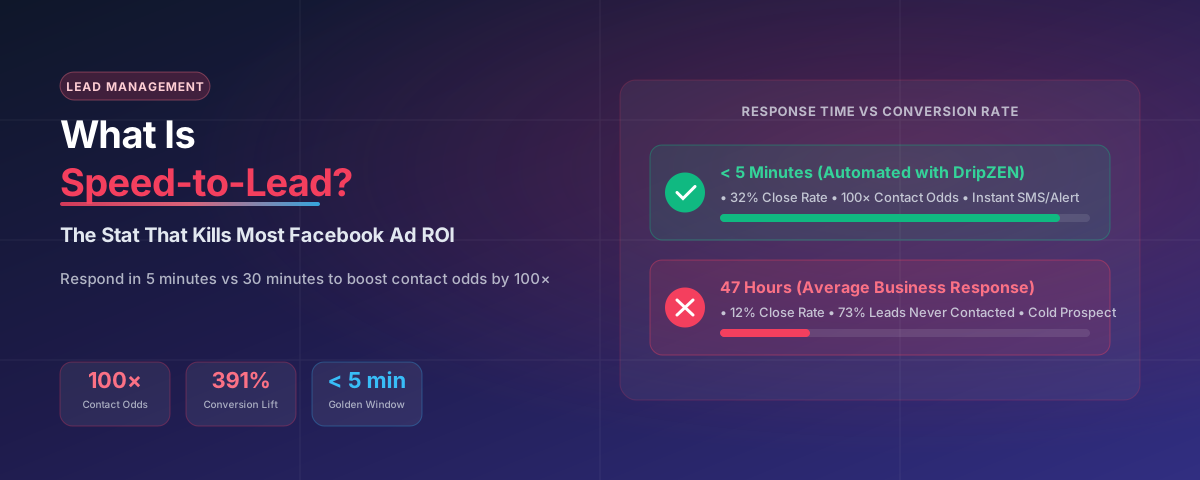
- Landmark MIT research proves you are 100× more likely to connect with a lead if you respond within 5 minutes versus 30 minutes.
- The average business takes 42–47 hours to respond — by which time conversion odds have plunged by over 90%.
- Only 0.1% of inbound leads are contacted within the 5-minute window, meaning 99.9% of competitors fail at basic lead response.
- Facebook leads are impulse-driven. Their intent decays faster than search leads, making fast response essential.
- DripZEN automates instant alerts, SMS auto-responders, and 24/7 coverage so you hit sub-5-minute speed effortlessly.
Introduction
If you're running Facebook ads for your small business or agency, every lead represents hard-earned ad spend. Yet across industries, up to 73% of marketing leads never receive a single call or message from sales. Of the leads that do get a response, the average wait time is nearly two full days (47 hours).
By the time a representative reaches out on day two, the prospect has forgotten filling out the ad form, fixed their problem elsewhere, or chosen a competitor who called back first.
This is the speed-to-lead problem— and it is quietly bleeding Facebook ad return on investment dry. In this guide, we'll explain the exact speed-to-lead definition, review the landmark academic studies, explore the mechanics of lead decay, and share practical steps to achieve sub-5-minute response times.
What Is Speed-to-Lead? (The Definition)
Speed-to-lead is the time between a prospect submitting their contact details (e.g., via a Facebook Lead Ad form or website inquiry) and your business executing its first meaningful response — whether through a phone call, SMS, or personalized email.
If someone asks for a clear speed to lead definition, here it is: it is the velocity at which your sales process reacts to fresh buyer intent.
Buyer intent reaches its absolute peak at the moment of form submission. The prospect's phone is in their hand, their problem is top of mind, and they haven't started evaluating alternative providers. Every minute that passes after submission erodes that peak intent.
The Concept of Lead Decay
Lead decay is the measurable drop in conversion probability that begins immediately after lead submission. Lead intent does not decline gradually over days; it drops on a steep exponential curve. Within 30 minutes, a lead has lost 60% of its initial conversion potential.
The Landmark Studies (The Data Behind Speed-to-Lead)
Speed-to-lead importance isn't based on opinion. Decades of data across millions of test leads prove the dramatic financial impact of response velocity:
1. MIT / InsideSales — The 100× Study
Dr. James Oldroyd at MIT Sloan analyzed over 15,000 leads and 100,000 call attempts. The landmark finding: the odds of connecting with a lead drop by 100 times when responding at 30 minutes compared to 5 minutes. Furthermore, the odds of qualifying the lead decrease by 21 times across that same 25-minute window.
2. Harvard Business Review — The Secret Shopper Audit
An HBR audit of 2,241 U.S. companies found an average response time of 42 hours. 23% of companies never responded at all. Companies contacting leads within 1 hour were 7 times more likely to qualify prospects than those waiting 2 hours, and 60 times more likely than those waiting 24+ hours.
3. Velocify — The 391% Conversion Lift
Analyzing 3.5 million leads, Velocify discovered that placing a call within 1 minute yielded a 391% increase in conversion rates compared to calling at the 2-minute mark.
4. Drift — The 7% Response Rate Benchmark
A mystery shopper study of 433 B2B companies revealed that only 7% of businesses responded within 5 minutes, while 55% failed to respond within 5 business days.
The Lead Decay Timeline: Minute-by-Minute Breakdown
Understanding how fast prospects lose interest highlights why human-only follow-up workflows fail:
| Time Elapsed | Relative Conversion Potential | Prospect State & Behavior |
|---|---|---|
| 0–5 Minutes | 100% (Peak) | Screen active, high recall, zero competitor intervention. |
| 5–30 Minutes | ~40% (60% drop) | Attention drifts, competitor tabs opened, scrolling resumes. |
| 30–60 Minutes | ~25% (75% drop) | Active comparison mode; evaluating 2–3 competing quotes. |
| 1–6 Hours | ~10% (90% drop) | Focus shifted to other tasks; purchasing decision deferred. |
| 6–24 Hours | ~5% (95% drop) | Cold lead territory; competitor outreach likely underway. |
| 24+ Hours | <1% | Functionally dead; requires cold email/nurture campaigns. |
Why Facebook Lead Ads Are Uniquely Vulnerable
Facebook leads behave differently than search traffic. Understanding these differences explains why traditional follow-up schedules fail for Facebook advertisers:
1. Impulse Scrolling vs. Active Search
Google users actively type search queries when seeking immediate solutions. Facebook users, by contrast, submit lead forms while passively scrolling social feeds. Because Facebook leads are impulse-driven, their brand recall fades far faster.
2. 52% of Facebook Leads Arrive After Hours
Over half of social ad conversions occur outside standard 9-to-5 business hours (evenings, weekends, late nights). If your lead processing waits for Monday morning, over 50% of your leads will sit uncontacted for 36+ hours. Data shows same-night after-hours responses achieve an 85% contact rate versus just 35% the next morning.
3. The Real Cost of Delayed Follow-Up
Consider a $5,000/month Facebook ad campaign generating 100 leads at $50 each:
- Responding <5 min (32% close rate): 32 new customers.
- Responding 24+ hr (12% close rate): 12 new customers.
That is a 20-customer penalty strictly caused by response lag. At a $500 customer lifetime value, slow follow-up costs $10,000 in lost monthly revenue on the exact same ad spend.
Industry Benchmarks: Where Does Your Business Stand?
Compare your current speed-to-lead against industry standards:
| Response Bracket | Operational Reality | Average Close Rate |
|---|---|---|
| Under 5 Minutes | Top 7–23% of companies. Instant automation active. | 32% |
| 5–30 Minutes | Above average, but missing peak intent. | 24% |
| 30–60 Minutes | Below average. Prospect evaluating alternatives. | 18% |
| 1–24 Hours | Poor response speed. Lead is cold. | 15% |
| 24+ Hours | Severe lead leakage. Massive ROI loss. | 12% |
How to Fix Speed-to-Lead: Automation with DripZEN
Relying on manual effort to hit 5-minute response times is unrealistic. Sales reps get stuck in meetings, drive between appointments, or take time off. The only sustainable solution is workflow automation.
DripZEN was built specifically to solve speed-to-lead for Facebook advertisers:
- Real-Time Facebook Sync: Instant lead ingestion with zero manual CSV exports.
- Multi-Channel Alerts: Immediate SMS, email, and mobile push alerts sent to your sales team the second a lead arrives.
- Instant SMS Auto-Responders: Send automated, personalized text replies within 60 seconds of submission.
- Smart Automated Sequences: Multi-touch follow-up keeps leads warm even if your team is tied up.
- 24/7 Coverage: Capture and engage after-hours leads immediately, achieving up to 85% evening contact rates.
Stop Letting Facebook Leads Go Cold
DripZEN instantly syncs Facebook leads, triggers instant SMS alerts, and automates sub-5-minute follow-up so you convert more ad spend into revenue.
Try DripZEN Free →Conclusion
So, what is speed to lead? It is the velocity at which your business responds to new potential customers — and it remains the single most underutilized competitive advantage in digital advertising.
The data across two decades of research is definitive: responding within 5 minutes boosts contact rates by 100× and conversion rates by up to 391%. Yet over 99.9% of businesses fail to hit this window consistently.
Calculate your own speed-to-lead today. Audit your last 50 leads and check the time between form submission and first contact. If that gap exceeds 5 minutes, fixing your follow-up speed is the fastest way to double your Facebook ad ROI.
FAQ: Speed-to-Lead
1. What is the exact definition of speed-to-lead?
Speed-to-lead is the time between a prospect submitting their contact information (such as filling out a Facebook Lead Ad) and your business making the first meaningful contact via phone call, SMS, or email.
2. Why is the 5-minute response window so critical?
Research from MIT shows that businesses responding within 5 minutes are 100 times more likely to connect with a lead and 21 times more likely to qualify them compared to waiting 30 minutes. Prospect intent decays exponentially after the first 5 minutes.
3. What is lead decay?
Lead decay is the measurable drop in conversion probability that starts immediately after a prospect submits a lead form. As time elapses, prospect recall drops, attention drifts to competitors, and conversion odds plummet by up to 90% within one hour.
4. Why are Facebook Lead Ads especially vulnerable to slow response times?
Facebook leads are impulse-driven captured while users scroll social media, rather than active searchers like on Google. Their intent fades rapidly, and over 52% of Facebook leads arrive outside normal business hours.
5. What is the average response time for small businesses?
Studies show the average business takes 42 to 47 hours to respond to an inbound lead, and up to 27% of leads never get contacted at all.
6. How can small teams consistently hit a sub-5-minute speed-to-lead?
Humans cannot consistently hit sub-5-minute response times manually due to meetings, sleep, and busywork. Teams rely on automated CRM tools like DripZEN to instantly trigger SMS alerts, auto-responders, and smart call tasks 24/7.