What Is AEO? How Answer Engine Optimization Is Changing How Businesses Get Found
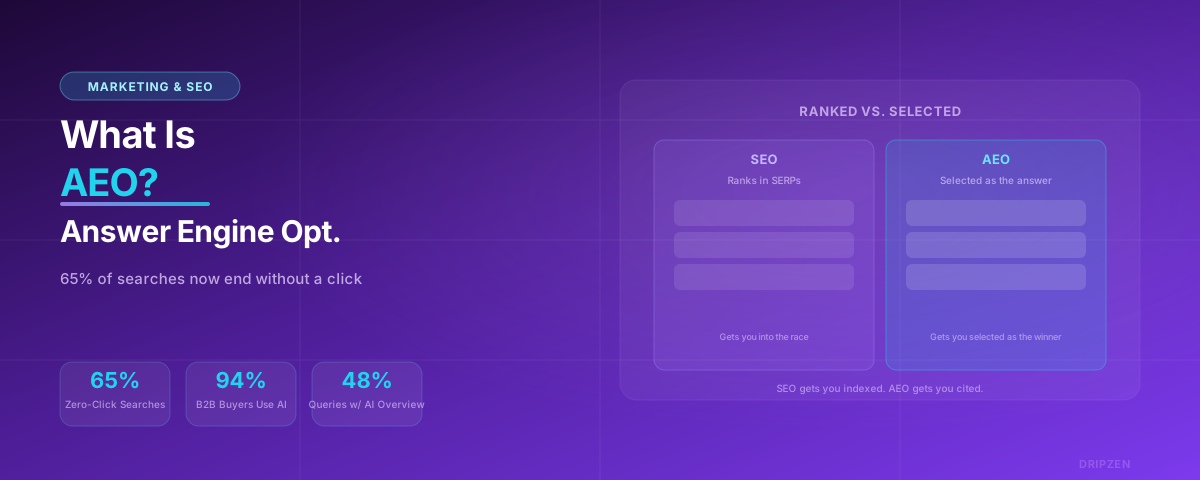
TL;DR — Key Takeaways:
- Answer Engine Optimization (AEO) is the practice of optimizing content to be selected as the direct answer in AI Overviews, featured snippets, voice search, and AI chatbots — not just to rank on a results page.
- 60–65% of searches now end without a click, and AI Overviews now appear on nearly half of all queries, cutting traditional click-through rates significantly when they show up.
- AEO vs SEO isn't a competition— they're complementary. SEO gets you into the race; AEO gets you selected as the answer.
- 94% of B2B buyers now use generative AI during their purchase process, and half start their research in an AI chatbot instead of Google Search.
- To implement AEO: answer first, use schema markup, build entity authority, and prioritize E-E-A-T.
- The businesses that master both AEO and SEO together will dominate the next era of search.
What Is AEO? (Answer Engine Optimization — Defined)
Answer Engine Optimization (AEO)is the process of optimizing content to appear as a direct answer in featured snippets, "People Also Ask" boxes, voice search, and AI Overviews. The core goal: become the direct answer to your user's question, not just a link they might click.
Here's a clear answer engine optimization definition: AEO is the practice of tailoring content to provide direct, concise answers to user queries — specifically for voice search, AI assistants, and zero-click experiences. Unlike SEO, which focuses on ranking, AEO focuses on being the definitive resource that gets selected by machines.
The Rise of AI Search
The search landscape has shifted dramatically, giving rise to AI search optimization — a new discipline focused on getting selected by AI-driven answer engines:
- ChatGPT handles roughly 2.5 billion queries per day, with over 900 million weekly active users, according to OpenAI's own disclosures.
- Perplexity AI processes around 780 million queries per month, per statements from its CEO.
- Google Gemini traffic grew 157%, reaching an estimated 1.1 billion monthly visits, per Similarweb data.
- AI chatbot traffic overall grew roughly 81% year-over-year to an estimated 55.2 billion visits.
Gartner has predicted that a quarter of organic traffic could shift to AI chatbots by 2026. Google is leading with AI Overviews, which per BrightEdge tracking now appear on nearly half of all queries. Seer Interactive's research found that when AI Overviews appear, organic click-through rate drops sharply. Traditional search gives you a list of links; AI search gives you a single best answer. AEO ensures that answer is yours.
Why AEO Matters Now (The Data)
The numbers tell a compelling story. Search is undergoing its most fundamental shift since 1998.
Zero-Click Searches Are the Norm
A widely-cited SparkToro/Datos zero-click study puts the numbers like this:
- 60–65% of all US Google searches end without a click.
- On mobile: as high as 77.2%.
- With an AI Overview present: around 83%, per Bain & Company research.
- In Google's AI Mode: as high as 93%, according to Semrush.
For every 1,000 Google searches, only about 360 result in a click. The rest end on the results page.
AI Is Reshaping B2B Buyer Behavior
The B2B world is experiencing this shift most dramatically:
- 94% of B2B buyers use generative AI during their purchase process, per 6sense's 2025 Buyer Experience Report.
- 50% of B2B buyers start their journey in an AI chatbot instead of Google Search.
- 85% purchase from their "day one" vendor list — if you're not visible when AI surfaces recommendations, you're losing before the buyer even starts comparing.
Question-Based Searches Are Exploding
People are asking more questions than ever:
- Question-based searches grew 163% from 2023 to 2026, according to an NP Digital analysis.
- 80% of all searches are informational.
- "People Also Ask" boxes appear in roughly 65% of searches, per Semrush.
Users don't want links. They want answers.
The Traffic Impact Is Real
Businesses are feeling the pain: an Onely/ABM Agency analysis found 73% of B2B websites lost traffic in 2024–2025, averaging a 34% decline. NP Digital reported B2B organic leads fell 47% over the same window.
But there's a silver lining: Seer Interactive's research found that brands cited in AI Overviews earn roughly 35% more organic clicks and 91% more paid clicks. Being selected amplifies visibility rather than cannibalizing it.
AEO vs SEO: What's the Difference?
The most common question we hear: "Is AEO replacing SEO?" The answer is a clear no. They serve different but complementary roles. SEO gets you into the race. AEO gets you selected as the winner.
Here's a detailed comparison across 13 dimensions:
| Dimension | SEO (Search Engine Optimization) | AEO (Answer Engine Optimization) |
|---|---|---|
| Primary Goal | Earn high-ranking positions in SERPs | Get selected as the direct answer in AI Overviews, voice search, and snippets |
| Core Focus | Improve rankings and drive organic traffic to your website | Provide direct, concise answers to AI-powered search engines |
| Query Patterns | Transactional, navigational, research-heavy | Question-led, conversational, zero-click intent |
| Content Type | Long-form depth, topic clusters, pillar pages | Short answers (40–60 words), Q&A blocks, scannable formats |
| Optimization Target | Google's ranking algorithm (links, content, technical) | AI systems that extract and synthesize answers |
| Success Metric | Traffic, rankings, CTR, conversions | AI citations, featured snippets, voice visibility, brand mentions in AI answers |
| Timeframe | Months to rank; long-term build | Can be selected quickly once authority is established |
| Audience | Searchers looking to visit websites | Users who want answers without clicking |
| Backlink Importance | Critical — a primary ranking factor | Reduced; focus shifts to authority and content quality |
| Content Format | Whole-page optimization | Chunk/snippet optimization, structured data, comparison tables |
| Platform Strategy | Google-centric, one-size-fits-all | Platform-specific (ChatGPT, Perplexity, Gemini, Google AI Overviews) |
| Measurement | SERP tracking, Google Analytics | AI visibility tools, citation tracking, manual prompt testing |
| Personalization | Low to medium | High — contextual, user-specific answers |
Why They Work Together
Research from Whitehat SEO found that 97% of AI Overview citations come from pages already ranking in the top 20. Traditional SEO is the prerequisite for AI visibility — SEO gets you indexed, AEO gets you selected. The gap between ranking and selection is growing: pages can rank well but never surface in AI responses, reducing brand presence even when SEO metrics look stable.
How AEO Works (The Technical Side, Simplified)
Here's how AEO works in five simple steps:
1. AI Systems Crawl for Direct Answers
AI search engines perform multiple background searches simultaneously, gather information from indexed pages, and synthesize a single response.
2. Structured Data Helps Machines Understand Context
AI systems rely on schema markup — structured code that tells machines what your content means. Pages with rich schema earn, per AirOps research, roughly 2.8 times higher citation rates.
3. Entity Authority Matters More Than Ever
AI evaluates who you are, not just what you wrote. Your digital footprint across LinkedIn, G2, Crunchbase, and Wikipedia factors into credibility. Search Atlas research suggests entity optimization produces 3–5 times more AI citations than schema alone.
4. Clear, Concise Answers Win
AI systems prioritize content with strong intent alignment, structured headings, specific facts, and E-E-A-T signals (Experience, Expertise, Authoritativeness, Trustworthiness).
5. Voice Search and Conversational Queries Drive Demand
With billions of voice assistants in use globally and roughly 52% of people using voice search daily, per Statista and Marketing LTB estimates, queries are becoming more conversational. AEO prepares your content for this shift.
How to Implement AEO for Your Business (8 Steps)
Ready to implement AEO? Here's a practical framework:
1. Answer First, Elaborate Second
Put the most direct, 40–60 word answerto the primary query at the top of your article — before any background. Write as if explaining to a chatbot user: short, simple, and human. Use question-based H2 headings and match real user phrasing from "People Also Ask."
2. Use FAQ Schema Markup
FAQPage schema is one of the most powerful AEO tools. Combined with QAPage, Search Atlas found it appears in roughly 41% of AI Mode citations with a 67% citation rate. Critical schema types: FAQPage, HowTo (which the same research found appears roughly 78% more often in AI step lists), Article, Organization + sameAs, and Speakable.
3. Build Entity Authority (Who You Are Matters)
Entity optimization is the #1 predictor of AI citations in much of the current research. Build it by declaring your entity through schema, ensuring consistency across profiles (LinkedIn, G2, Crunchbase, Wikipedia), earning third-party validation, and mapping entity relationships.
Search Atlas found B2B companies with 50+ G2 reviews earned roughly 3.2x more Perplexity citations, and an Ahrefs Evolve 2025 study found branded web mentions to be the single strongest predictor of AI Overview citation, with a 0.664 correlation.
4. Optimize for Featured Snippets
Structure content in AI-friendly formats: lists for "how to," tables for comparisons, and definitions(40–60 words) for "what is" queries. Google has cut traditional featured snippets by roughly 35% as AI Overviews took over, but the same structuring principles apply to AI answers.
5. Write Conversationally (Match How People Ask)
AI systems are trained on natural language. Write conversationally: use long-tail keywords, target question-based phrases, keep sentences short, and answer follow-ups before they're asked. The average voice query is only around 4.2 words, but AI assistants also process long prompts — match both.
6. Create Question-Based Content Clusters
Build content around entities and topics, not just keywords. Create clusters with a pillar page and supporting sub-pages, linked internally to show topical depth. Cover informational, navigational, and transactional intent — roughly 80% of searches are informational, so your strategy should reflect that.
7. Prioritize E-E-A-T
AI systems prioritize content from credible experts. Strengthen your E-E-A-T by adding author bios, citing reputable sources, including original data, updating content regularly (AirOps research found pages not updated in 3+ months are roughly three times more likely to lose AI citations), and building comprehensive topic clusters.
8. Measure AEO Success
Traditional SEO metrics (traffic, CTR, position) are losing value on their own. Track these AEO-specific metrics instead:
- Featured snippet captures — are you the answer in Google?
- AI citation rates — how often are you cited in ChatGPT, Perplexity, and Gemini?
- Brand mentions in AI answers — is your brand appearing in AI-generated responses?
- AI referral traffic — visitors from AI platforms, a category growing several hundred percent year-over-year in recent tracking
- "People Also Ask" appearances — visibility in Google's expandable Q&A boxes
- Voice search query captures — are voice assistants reading your content?
- Zero-click impressions — brand visibility even without clicks
Tools: Google Search Console, SEMrush/Ahrefs, AirOps, and manual prompt testing across platforms.
The Future: AEO + SEO Together
Let's address the elephant in the room: SEO is not dead. It's evolving. SEO remains the foundation — without it, your content isn't indexed, crawlable, or competitive. AEO is the new layer on top: optimization for selection, not just ranking. As voice search, AI assistants, and zero-click results become the new normal, the brands that thrive will be those structured to be the answer.
This blog post itself is structured for AEO. Notice the answer-first paragraphs, the clear H2 headings phrased as questions, the structured comparison table, and the concise definition right at the top. We're practicing what we preach.
The search landscape is changing. The question is whether your business will change with it.
Turn Leads Into Customers While You Optimize for Discovery
Getting found is only half the battle — DripZEN makes sure every lead that finds you actually gets followed up with, fast.
Try DripZEN Free →Conclusion
What is answer engine optimization?It's the most important shift in search strategy since SEO itself.
AEO isn't about replacing SEO — it's about evolving with how people search. When 60–65% of searches end without a click, when AI Overviews appear on nearly half of queries, and when 94% of B2B buyersuse generative AI, the old playbook isn't enough. Be the answer, not just a link.
AEO is learnable, implementable, and measurable. Start with the eight steps above. Answer first. Use schema. Build entity authority. Track your AI citations.
The future of search belongs to businesses that understand one truth: users don't want to search. They want to be answered.
At DripZEN, we believe the future of marketing is about being found in the right moments — and converting that visibility into real conversations before a lead goes cold.
FAQ: What Is AEO?
1. What is the simplest definition of AEO?
Answer Engine Optimization (AEO) is the practice of structuring content so AI Overviews, chatbots, and voice assistants select it as the direct answer to a query — instead of optimizing purely to rank on a search results page.
2. Is AEO replacing SEO?
No. SEO and AEO are complementary, not competing. SEO gets your content indexed, crawlable, and ranking — the prerequisite for visibility at all. AEO is the layer on top that determines whether AI systems actually select and cite your content as the answer. Most AI citations come from pages that already rank well.
3. How do I measure AEO success?
Track AI citation rates across ChatGPT, Perplexity, and Gemini; brand mentions inside AI-generated answers; featured snippet captures; "People Also Ask" appearances; AI referral traffic; and voice search query captures. Traditional metrics like rankings and click-through rate still matter, but they no longer tell the whole story.
4. What is entity authority, and why does it matter for AEO?
Entity authority is how consistently and credibly your brand shows up across the web — your website, LinkedIn, G2, Crunchbase, Wikipedia, and other third-party sources. AI systems evaluate who is answering, not just what was written, so a strong, consistent digital footprint makes AI systems more likely to trust and cite you.
5. What schema markup matters most for AEO?
FAQPage and HowTo schema are the highest-impact types, since they map directly onto the question-and-answer format AI systems extract from. Article, Organization with sameAs links, and Speakable schema round out a solid technical foundation.
6. How long does it take to see AEO results?
It varies, but AI citations can appear faster than traditional rankings once a page has enough authority and structure — there is no months-long ranking climb required in the same way. That said, entity authority and E-E-A-T signals build over time, so consistency matters more than any single optimization.
7. How does DripZEN think about AEO for small businesses?
We publish every guide answer-first, with clear schema, structured comparisons, and FAQ sections — practicing the same AEO principles we write about. For small businesses without a dedicated SEO team, the highest-leverage first step is usually adding FAQ schema to your existing best-performing pages.