Sales Pipeline Management for Non-Sales People: A Simple Guide
TL;DR — Key Takeaways:
- A sales pipeline is just a visual to-do list for your deals.
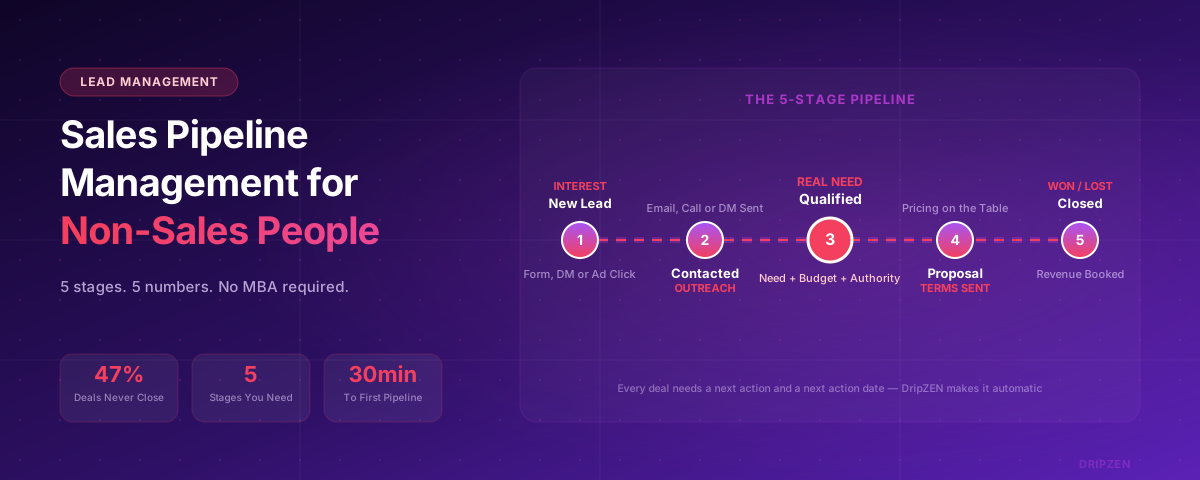
- You only need 5 stages: New Lead → Contacted → Qualified → Proposal → Closed Won/Lost.
- 47% of forecasted deals never close without proper pipeline management.
- Track 5 numbers to know if your sales are healthy: win rate, deal size, sales cycle, pipeline value, and stage conversion rates.
- Build your first pipeline in a spreadsheet in under 30 minutes — no MBA required.
- Sales is a skill, not a talent. With structure and consistent follow-up, anyone can get good at it.
Introduction
You didn't start your business to become a salesperson — but here you are. You're the founder, the marketer, the product builder, and somehow also the person chasing down leads. You have a dozen promising conversations happening in Slack, email, LinkedIn DMs, and your Notes app. Some feel like they're going somewhere. Others? You've completely forgotten when you last followed up.
If that sounds familiar, you're not broken — you just need a sales pipeline management guide built for people who never had formal sales training. This article is your jargon-free roadmap to tracking deals, following up consistently, and finally feeling in control of your sales. By the end, you'll know exactly how to build a simple sales pipeline for small business that works even if you don't have a sales bone in your body.
What Is a Sales Pipeline? (And Why You Need One)
A sales pipeline is simply a visual list of every deal you're working on, organized by where each one stands in your selling process. Think of it as a Kanban board for your revenue.
Here's the easiest way to understand it: a pipeline tracks what you are doing. A sales funnel, by contrast, tracks what the buyer is experiencing. The funnel is about their journey; the pipeline is about your to-do list. Focus on the pipeline first.
Why Small Businesses Especially Need Structure
When you're a team of one or three, there's no sales manager checking your numbers. Deals live in your head, email threads, and forgotten tabs. Research shows that 90% of startups fail within their first decade, and sales execution is one of the top three failure factors. Not product quality. Sales execution.
And the cost of not having a pipeline? 47% of forecasted deals never close — and 79% of B2B deals stall due to poor opportunity management. Without a clear view of where every deal stands, you can't spot problems early, forecast revenue, or prioritize your time. A pipeline management approach built for non-sales people gives you the structure you need without the complexity you don't.
The 5 Simple Stages Every Pipeline Needs
You don't need a six-figure CRM with 27 stages to sell well. In fact, the best advice for beginners is to keep it to five stages or fewer — more stages create confusion and slow adoption.
Here are the five stages that work for almost any small business or founder:
| Stage | What It Means | Exit Criteria (When to Move Forward) |
|---|---|---|
| 1. New Lead | Someone showed interest — filled a form, replied to an email, met you at an event, or clicked your ad. | You've made first contact or they're in your system for follow-up. |
| 2. Contacted | You've reached out. Email, call, DM, or meeting request sent. | They responded and agreed to a conversation. |
| 3. Qualified | You've confirmed they have a real need, budget, and authority to decide (or at least recommend). | They meet your basic qualification criteria and want to keep talking. |
| 4. Proposal | You've sent pricing, scope, or a formal proposal. Terms are on the table. | They confirmed the proposal addresses their needs. |
| 5. Closed Won or Closed Lost | The deal is done — either signed or not. | Revenue booked (Won) or reason recorded (Lost). |
The golden rule: Every deal in your pipeline must have a "next action" and a "next action date." If a deal has no next step scheduled, it's not in your pipeline — it's in your wishlist. Move it to "Lost" and move on.
How to Build Your First Pipeline (Step-by-Step)
You can set up your first pipeline this afternoon. No software engineering required.
Pick a Tool
Start with what you have. Options include:
- A spreadsheet (Google Sheets or Excel) — zero cost, zero learning curve.
- A free CRM like HubSpot CRM — free forever for basic use.
- A visual tool like Pipedrive — starts at $14/user/month, very intuitive.
- DripZEN — built for founders who want pipeline + follow-up automation in one place.
The right tool is the one you'll actually use. Fancy doesn't matter if you don't log in.
Define Your 5 Stages
Use the five stages above, or tweak them to match your business. If you sell services, "Proposal" might become "Scope Sent." The labels don't matter — the progression does. This is your small business sales process — make it yours.
Add Your Current Leads
Gather every open deal from your email, DMs, notes app, and memory. Add them with these columns:
| Column | Example |
|---|---|
| Company/Contact Name | Acme Corp — Sarah Johnson |
| Deal Value | $5,000 |
| Stage | Qualified |
| Probability of Close | 25% |
| Expected Close Date | July 15, 2026 |
| Next Action | Send proposal |
| Next Action Date | July 3, 2026 |
| Notes | Met at SaaS conference; needs team plan |
Set Follow-Up Reminders
This is where most non-sales people drop the ball. The best pipeline is useless if you don't act on it. Most sales require 5–7 touchpoints before conversion — yet many founders give up after one or two attempts. Set calendar reminders or use automation to prompt follow-ups.
Review Weekly
Pick one day a week to review every deal. Ask:
- Does this deal still have a next action with a date?
- Is this deal realistically going to close, or am I keeping it alive out of hope?
- What do I need to do next week to move the most important deals forward?
Pro tip: Start with a spreadsheet. If you outgrow it in 3–6 months, that's a good problem — it means your pipeline is working.
The 5 Numbers You Must Track
You don't need a dashboard with 40 metrics. Track these five, and you'll know more about your sales health than most people:
1. Win Rate
What it is: The percentage of deals you close out of all opportunities you work on.
Formula: Win Rate = (Deals Won / Total Opportunities) × 100
Why it matters: The average B2B win rate is just 21%. If yours is below 15%, you may be qualifying too loosely. Above 50%, your pipeline might be too narrow.
2. Average Deal Size
What it is: How much revenue each closed deal brings in on average.
Formula: Average Deal Size = Total Revenue / Number of Deals Won
Why it matters: Research shows that startups typically underprice their offerings by 30–50% in their first year — so watch this number closely.
3. Sales Cycle Length
What it is: The average number of days from first contact to closed deal.
Formula: Sales Cycle Length = Total Days from Contact to Close / Number of Deals
Why it matters: The average B2B sales cycle hit 6.7 months in 2025, up from 4.9 months in 2019. But for small deals under $15,000, cycles are typically just 14–30 days. If yours is much longer, look for bottlenecks.
4. Pipeline Value
What it is: The total value of all deals currently in your pipeline.
Formula: Pipeline Value = Sum of (Deal Value × Probability of Close) for each open deal
Why it matters: This tells you if you have enough deals in play to hit your revenue goals. Healthy pipelines have 3x to 5x coverage — your pipeline value should be 3–5 times your target revenue.
5. Conversion Rate by Stage
What it is: The percentage of deals that move from one stage to the next.
Formula: Stage Conversion = (Deals that reached the next stage / Deals that entered this stage) × 100
Why it matters: This reveals where deals get stuck. If 80% of leads move from "Contacted" to "Qualified" but only 20% move from "Proposal" to "Closed," you know where to focus.
Start with just two numbers this week: "How many deals are in my pipeline?" and "What's my expected revenue this month?" Add the others once you have 10+ deals.
Common Mistakes Non-Sales People Make
Even smart founders mess up sales. Here's what to avoid:
- ❌ Overcomplicating the Process: You don't need 12 stages, custom fields, and a weighted forecast model. You need a list of deals, a next action for each, and a weekly review. 22% of sales professionals are still unsure about what CRM actually is — don't let complexity scare you away from starting simple.
- ❌ Not Following Up Consistently: Sales reps spend about 60% of their time on non-selling tasks like data entry — and the rest often gets spent on new leads instead of nurturing existing ones. Follow-up is where deals are won. Set a reminder system and stick to it.
- ❌ Keeping Dead Leads in the Pipeline: Hope is not a strategy. If a lead hasn't responded after 5–7 touchpoints, mark them "Lost" and move on. A bloated pipeline feels comforting but makes your forecasting meaningless.
- ❌ Not Asking for the Sale: Many non-sales founders are great at building relationships but freeze when it's time to ask for a signature. If you've done the work to understand their problem and present a solution, asking for the business is a service, not an imposition.
- ❌ Giving Up Too Early: It takes an average of eight cold call attempts to reach a prospect today. Most people give up after two. Your persistence is your competitive advantage.
Tools That Make It Easy
You don't need a big budget to get started. Here are the most beginner-friendly options:
71% of small businesses already use a CRM — the tools are more accessible than ever. Pick one and start; you can always switch later.
Your 30-Day Action Plan
You don't need to overhaul everything today. Here's a week-by-week plan to get your sales pipeline for beginners up and running:
| Week | Focus | Actions |
|---|---|---|
| Week 1 | Set Up Your Pipeline | Open a spreadsheet or sign up for a free CRM. Create your 5 stages. Add every open deal you can think of. Schedule your weekly review time (30 minutes, same day every week). |
| Week 2 | Add All Current Leads | Scrape your email, LinkedIn, calendar, and notes for leads you've forgotten. Give every deal a next action and a date. Assign a probability to each deal. |
| Week 3 | Implement a Follow-Up Schedule | For every deal in "Contacted" or "Qualified," schedule the next touchpoint. Use a simple sequence: Day 0 (thank you), Day 2 (share a resource), Day 5 (check-in), Day 10 (last try). Set calendar reminders or automate with DripZEN. |
| Week 4 | Review and Optimize | Run your numbers: win rate, deal size, average cycle length, pipeline value. Identify your biggest bottleneck. Close out any dead deals with no next action. Celebrate the progress — you've built something most founders never do. |
Conclusion
Sales isn't a mysterious talent — it's a skill that gets better with practice and structure. This sales pipeline management guide was built for people who never planned to be in sales but found themselves there anyway. You don't need an MBA, a sales team, or expensive software to build a pipeline that works.
Start simple. Track your five stages. Follow up. Measure your numbers. Review weekly. That is the formula.
84% of salespeople miss their sales quota — but that doesn't have to be you. With a clear pipeline and discipline, you can be more organized and more confident than most.
Stop Letting Deals Slip Through the Cracks
DripZEN gives non-sales founders a visual pipeline plus automated follow-up in one mobile-first app — so every deal has a next action and no lead gets forgotten.
- Visual pipeline — New → Contacted → Qualified → Won, at a glance
- Automated follow-up reminders — never drop the ball on a warm lead
- Real-time lead capture — leads flow straight into your pipeline
- Team assignment — clear ownership, zero confusion
Frequently Asked Questions
What is a sales pipeline in simple terms?
A sales pipeline is a visual list of every deal you are working on, organized by where each one stands in your selling process — like a Kanban board for your revenue. It tracks what you are doing, while a sales funnel tracks what the buyer is experiencing.
How many stages should my sales pipeline have?
Five stages or fewer. The five that work for almost any small business are: New Lead, Contacted, Qualified, Proposal, and Closed Won/Lost. More stages create confusion and slow adoption — you can always add complexity later once the basics are working.
Do I need a CRM to manage a sales pipeline?
Not at first. A spreadsheet works fine for your first 2–6 months and up to about 50 customers. Once you outgrow it, move to a free CRM or a mobile-first tool like DripZEN that combines pipeline tracking with automated follow-up. The right tool is the one you will actually use.
What numbers should I track in my sales pipeline?
Track five: win rate, average deal size, sales cycle length, pipeline value, and stage-by-stage conversion rate. Start with just two — how many deals are in your pipeline and your expected revenue this month — and add the rest once you have 10 or more deals.
How often should I review my sales pipeline?
Once a week, same day every week, for about 30 minutes. Check that every deal has a next action with a date, close out dead deals that are only alive out of hope, and decide what you need to do next week to move your most important deals forward.