The 5-Minute Lead Follow-Up Framework (For Facebook Advertisers)
TL;DR — Key Takeaways:
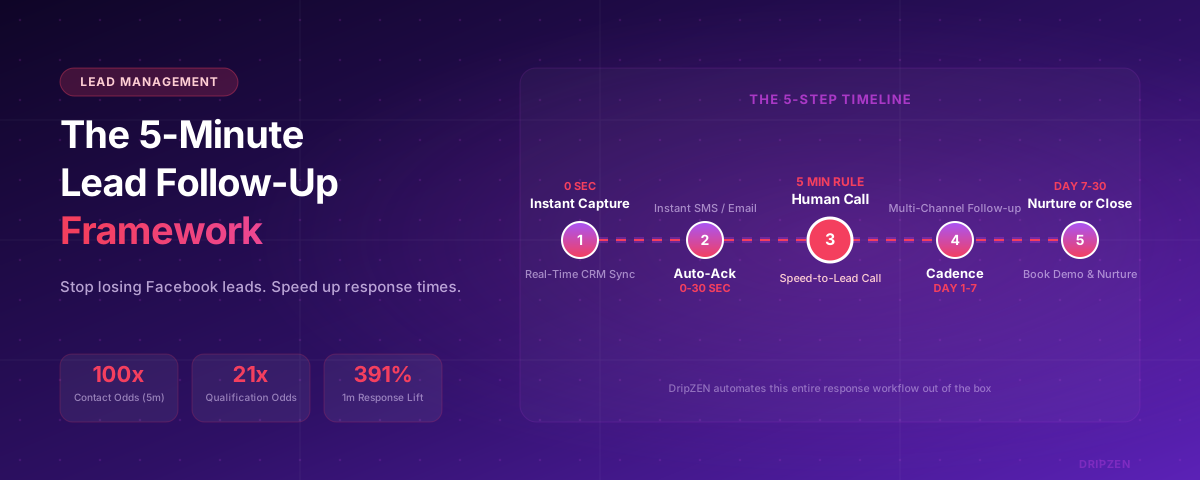
- Responding within 5 minutes makes you 100x more likely to connect and 21x more likely to qualify a lead compared to waiting 30 minutes.
- The average business takes 42–47 hours to respond — only 7% consistently hit the 5-minute window.
- This 5-step framework covers: Instant Capture → Auto-Acknowledgment → Human Response → Structured Follow-Up → Nurture or Close.
- Companies using automated follow-up see 40% higher lead-to-customer conversion and 65% shorter sales cycles.
Introduction: The 5-Minute Advantage
What if responding to a lead in 5 minutes instead of 5 hours could 10x your conversion rate? It sounds like a marketing exaggeration — until you look at the data.
MIT research analyzing over 1.25 million leads found that companies responding within 5 minutes are 100 times more likely to make contact and 21 times more likely to qualify that lead than those waiting just 30 minutes. Yet the average business still takes 42 to 47 hours to respond, and only 7% of companies consistently hit the 5-minute mark.
If you are running Facebook ads, this gap is both your biggest problem and your greatest competitive advantage. Every lead sitting uncontacted in your Ads Manager is a potential customer drifting toward a competitor who responded faster. This post gives you a complete, actionable lead follow up framework you can implement today — no fluff, just a system that works.
Why 5 Minutes? The Science Behind Speed-to-Lead
Dr. James Oldroyd’s landmark research published in Harvard Business Review analyzed lead response behavior across 2,241 U.S. companies and over 1.25 million leads. The findings are stark:
- Contact odds drop 100x when you wait 30 minutes instead of 5
- Qualification odds drop 21x over the same period
- Firms responding within 1 hour are 7 times more likely to qualify a lead than those waiting even one hour longer
- Firms waiting 24+ hours are 60 times less likely to ever convert that lead
A separate study by Velocify found that responding within 1 minute increases conversion rates by 391% compared to waiting just 2 minutes. The first 60 seconds are transformational.
Leads do not age linearly. They decay exponentially. Drift’s research confirms that waiting just 5 minutes increases your risk of losing a lead by 10x; at 10 minutes, that risk jumps to 100x. Your prospect is in "buying mode" at the moment of submission. Five minutes later, their attention has shifted — or a competitor has already called. Speed is not just a metric; it is a competitive weapon.
Facebook Lead Specific Considerations
Facebook leads are especially perishable:
- Facebook does not send priority notifications when someone fills out your lead form. Leads often sit in Ads Manager for hours before anyone notices.
- Meta stores each lead for only 90 days — if you do not sync them promptly, they expire.
- Manual Facebook lead management costs an average of $47 per lead in lost conversion opportunities.
- 52% of leads come in outside standard business hours.
If your system depends on someone checking Facebook Ads Manager every few hours, you are already losing money.
The Framework: 5 Steps in 5 Minutes
This speed to lead framework is designed specifically for businesses running Facebook ads. Each step builds on the last, creating a seamless system that catches every lead and moves it through your pipeline efficiently.
Instant Capture (0 Seconds)
The Goal: Every lead enters your system the moment they submit — no manual exports, no CSV downloads, no delays.
What to do:
- Connect your Facebook Lead Ads directly to your CRM via a real-time integration (native Meta integrations, Zapier, LeadsBridge, or an all-in-one platform like DripZEN).
- Map Facebook form fields to your CRM fields so data flows automatically.
- Pre-fill form fields using Facebook profile data to reduce friction and improve lead quality.
- Keep forms to 3–5 essential fields for maximum completion rates.
The Standard: Lead appears in your system within seconds of form submission.
Auto-Acknowledgment (0–30 Seconds)
The Goal: The lead knows you received their information, knows what to expect next, and feels acknowledged.
What to send: An automated SMS or email that includes confirmation of receipt, a specific timeline for human contact ("You will hear from us within 5 minutes"), and clear next steps.
Why this works:
- Welcome emails have an average open rate of 68.6%; real-time welcome emails hit 91.43% with a 26.9% click-through rate.
- An automated SMS with a simple yes/no question can filter out 70% of non-serious inquiries while maintaining 82% response rates from genuinely interested prospects.
- 82% of consumers expect responses within 10 minutes, and 64% expect real-time responses.
First Message Template (SMS):
"Hi [Name], this is [Your Name] from [Company]. I just saw your request come through on Facebook. Thanks for reaching out! I will give you a quick call in the next 5 minutes to answer your questions. – [Your Name]"
Human Response (1–5 Minutes)
The Goal: A real person makes contact while the lead is still engaged and expecting your call.
What to do:
- Call first. A phone call within 5 minutes is the gold standard.
- If no answer, send a follow-up text immediately.
- Use a simple script that references their specific inquiry.
- Ask 2–3 qualification questions to assess fit and urgency.
Why this matters:
- Only 27% of Internet leads ever get contacted at all.
- Sales reps make an average of only 1.3 call attempts before giving up.
- It takes 6–8 touchpoints to engage a buyer, yet nearly half of salespeople stop after one attempt.
- Companies using a 24/7 response capability convert at 2.5x the rate of 9-to-5 operations.
5-Minute Call Script:
"Hi [Name], this is [Your Name] from [Company]. I just received your request from Facebook — wanted to reach out quickly while it was fresh. You mentioned you are interested in [service/product]. Can you tell me a bit about what you are looking to solve? [Listen] Great. Based on what you have shared, here is how we typically help... What does your timeline look like?"
Key Qualification Questions:
- What prompted you to look into this now?
- What is your ideal timeline for getting started?
- Have you used a similar service before?
Structured Follow-Up (Day 1–7)
The Goal: For leads who do not convert on the first contact, maintain persistent but helpful touchpoints across multiple channels.
The Multi-Channel Cadence:
| Day | Touchpoint | Channel | Purpose |
|---|---|---|---|
| 0 | Initial response | Call + SMS | Immediate contact |
| 0 | Auto-acknowledgment | SMS/Email | Set expectations |
| 1 | Follow-up #1 | Call | First callback if no answer |
| 1 | Value-add email | Send helpful resource | |
| 2 | Follow-up #2 | SMS | Short check-in |
| 3 | Follow-up #3 | Call + Email | Different time of day |
| 5 | Follow-up #4 | SMS | Social proof or case study |
| 7 | Follow-up #5 | Direct booking link or offer |
Key Principles:
- Multi-channel outreach improves response rates by 63%.
- Touches 3 through 5 account for approximately 40% of total booked appointments.
- 68% of booked jobs came from leads who did not respond to the first two messages.
- Alternate between calls, SMS, and emails to avoid fatigue.
- Reference the original inquiry in every contact to maintain context.
Companies using all three elements — immediate acknowledgment, fast human follow-up, and persistent nurture — see 45% higher conversion rates than single-channel responders.
Nurture or Close (Day 7–30)
The Goal: Convert warm leads into appointments, and keep long-term prospects engaged until they are ready to buy.
For Immediate Buyers (Days 7–14):
- Send a direct booking link with available time slots.
- Offer a limited-time incentive or bonus.
- Use a "break-up" email if they have not engaged: "I do not want to clutter your inbox if this is not a priority. Just reply YES and I will keep you in the loop."
For Long-Term Nurture (Days 14–30+):
- Move to a weekly nurture cadence (one touch per week).
- Share valuable content: case studies, testimonials, how-to guides.
- Segment by interest level — high-intent leads get 2–3 touches per week, long-cycle leads get one touch every 2–4 weeks.
Why nurture matters:
- Companies excelling at lead nurturing generate 50% more sales-ready leads at 33% lower cost, and nurtured leads make 47% larger purchases.
- Only 2% of sales close after the first contact — it typically takes 12–13 touches to turn a lead into a qualified opportunity.
When to Disqualify:
- No engagement after 8–10 touches across 30 days.
- No response to a direct "break-up" message.
- Lead explicitly states they are not interested or does not match your ideal customer profile.
Tools to Implement This Framework
You do not need enterprise software to execute this lead follow up cadence. Here are the categories of tools that make it work:
DripZEN: The All-in-One Solution
If you are tired of stitching together five different tools, DripZEN is designed specifically for businesses running Facebook ads. It handles the entire facebook lead follow up strategy in one platform:
- Instant Facebook Lead Capture: Leads flow directly from your ads into DripZEN in real time — no CSV exports, no manual imports.
- Automated Multi-Channel Follow-Up: SMS, email, and call reminders triggered automatically based on lead behavior.
- Smart Lead Routing: Automatically assigns leads to the right team member based on territory, availability, or round-robin rules.
- Built-in Cadence Builder: Create the exact Day 0–30 follow-up sequence outlined in this framework without writing code.
- Response Time Tracking: Monitor your team’s speed-to-lead performance and identify bottlenecks.
Bottom line: DripZEN replaces your CRM, your Zapier automations, your email tool, and your SMS platform — so your team can focus on selling instead of managing software.
Common Mistakes to Avoid
Even with the best framework, these pitfalls will kill your results:
- ❌ Waiting for "Perfect" Systems: Start with Step 1 and Step 2, then build from there. A simple automated SMS + manual callback within 5 minutes beats a complex system that never launches.
- ❌ Over-Automating and Losing the Human Touch: Automation handles the first 30 seconds. After that, humans convert leads. A generic drip sequence without personalized outreach will not close deals.
- ❌ Giving Up Too Soon: 68% of booked jobs come from leads who ignored the first two messages. If you stop after one call attempt, you are leaving the majority of your revenue on the table.
- ❌ Not Tracking Metrics: You cannot improve what you do not measure. Track your average response time, contact rate, and conversion rate by lead source.
- ❌ Ignoring After-Hours Leads: 52% of leads come in outside business hours. Auto-acknowledgments and scheduled next-day callbacks are essential for after-hours coverage.
Measuring Success: KPIs to Track
Implementing a 5 minute lead response system is only half the battle. You need to measure whether it is actually working. Here are the metrics that matter:
| KPI | Target | Why It Matters |
|---|---|---|
| Response Time | Under 5 minutes | Average B2B response time is 42–47 hours; only 7% hit 5 minutes. |
| Contact Rate | 80–90% within 24 hours | Manual follow-up achieves 20–30%; automated systems achieve 80–90%. |
| Qualification Rate | 30–50% of contacted leads | Measures how well your targeting and messaging align with ideal prospects. |
| Conversion Rate | 10–15% with automation | Manual follow-up typically converts at 1–2%; automation lifts this to 10–15%. |
| Cost Per Acquisition | Decreasing trend | Faster follow-up improves conversion, lowering effective CPA without changing ad spend. |
| Follow-Up Persistence | 6–8 touchpoints per lead | Nearly half of salespeople stop after one attempt; it takes 6–8 touches to engage most buyers. |
Conclusion: Your Lead Follow Up Framework Starts Now
The data is unambiguous: speed wins. Companies that respond to leads within 5 minutes are 100x more likely to connect and 21x more likely to qualify than those that wait. The average business takes 42–47 hours to respond, leaving a massive gap for you to exploit.
This lead follow up framework gives you a complete system: Instant Capture, Auto-Acknowledgment, Human Response within 5 minutes, Structured Follow-Up over 7 days, and Nurture or Close for long-term prospects. You do not need a complicated tech stack to start. You need a decision to respond faster than your competitors — and a tool that makes it automatic.
Never Let Another Facebook Lead Go Cold
DripZEN connects directly to your Facebook Lead Ads and puts every lead in front of your team within seconds of submission — with a visual pipeline that makes follow-up impossible to forget.
- Real-time lead sync — no manual CSV exports, no missed leads
- Instant push notifications — follow up before competitors do
- Visual pipeline — New → Contacted → Qualified → Won
- Team assignment — clear ownership, zero confusion
Frequently Asked Questions
Why is the first 5 minutes so critical for lead follow-up?
MIT research shows that responding to a lead within 5 minutes makes you 100 times more likely to make contact and 21 times more likely to qualify that lead than waiting 30 minutes. Prospect interest decays exponentially from the second they submit a form.
What if my team receives leads outside standard business hours?
Over 52% of leads come in outside of standard 9-to-5 business hours. Your system must handle this by utilizing instant auto-acknowledgment SMS/emails to set expectations and scheduling automated call alerts for your sales team the next morning.
How do I automate the instant capture of Facebook leads?
You can connect Facebook Lead Ads directly to your CRM using native Meta integrations, third-party connectors like Zapier or LeadsBridge, or an all-in-one mobile-first tool like DripZEN that automatically syncs leads in real time without coding.
How many touchpoints should be in a lead follow-up sequence?
A structured cadence should have between 6 to 8 touchpoints spanning over 7 to 30 days. Since 68% of booked jobs come from leads who did not respond to the first two messages, persistence is crucial for optimizing conversion rates.
Do I need a complex CRM to implement this framework?
No. A complex system that your team resists using is worse than a simple spreadsheet or mobile-first CRM. DripZEN is built specifically for small businesses to manage, assign, and track Facebook lead follow-ups from their phones.