
What Is a Facebook Leads CRM? (Definition, Features & Top Tools)
TL;DR — Key Takeaways:
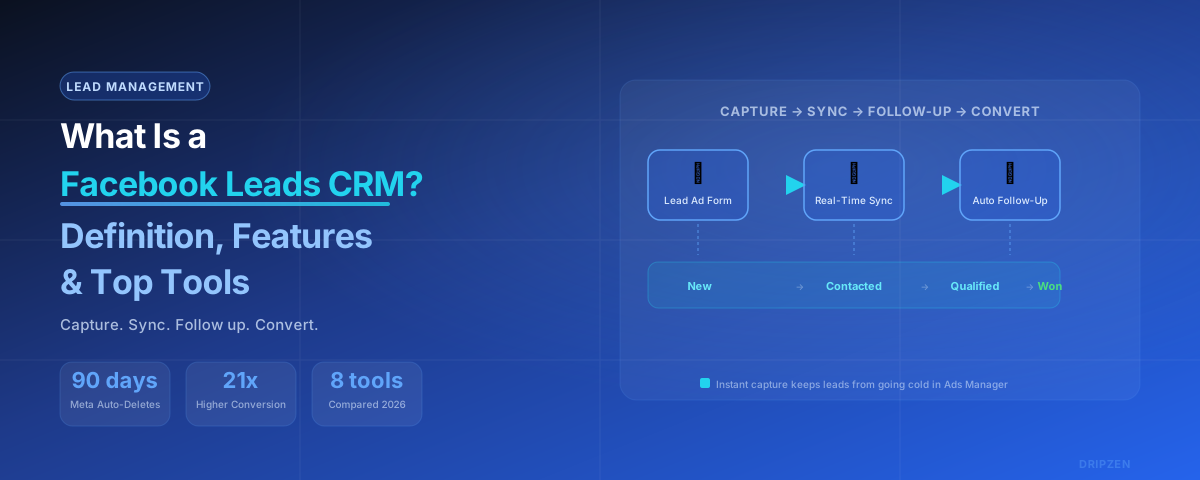
- A Facebook Leads CRM connects directly to Meta Lead Ads for instant capture, real-time sync, and automated follow-up.
- It differs from a general CRM by focusing narrowly on speed-to-lead — the critical first minutes after form submission.
- Facebook deletes lead data after 90 days; most manual processes take 24–48 hours to respond.
- Leads contacted within 5 minutes are 21x more likely to convert than those contacted after 30 minutes.
- Top tools include HubSpot, Salesforce, GoHighLevel, Pipedrive, Zoho, ActiveCampaign, Keap, and Freshsales — pick by budget and team size.
Introduction
You've been running Facebook ads for three weeks. Leads come in — twenty, thirty, fifty a day. But check Ads Manager and they're just sitting there. A spreadsheet download here, a manual copy-paste there. By the time someone calls a lead, three days have passed.
This is the invisible problem behind every Facebook Lead Ads campaign: getting leads is easy, managing them is hard. Facebook makes it simple to collect names, emails, and phone numbers. It doesn't make it simple to turn those contacts into customers. That's where a Facebook Leads CRM changes everything.
If you've wondered what is Facebook leads CRM and whether your business needs one, this guide covers the Facebook leads CRM definition, the lead management CRM features that matter, and how to pick the right CRM for Facebook ads from the top tools available in 2026.
What Is a Facebook Leads CRM? (The Definition)
A Facebook Leads CRM is a customer relationship management system specifically designed — or configured — to capture, organize, and convert leads generated through Facebook and Instagram advertising.
In plain terms: it's a smart inbox for your Facebook leads. When someone taps your lead ad and fills out an Instant Form, their information flows straight into the CRM instead of sitting in Meta's Ads Manager. From there, the CRM can assign the lead, trigger automated follow-ups, and track every interaction until the deal closes.
How It Differs from a General CRM
A general CRM manages the entire customer lifecycle — from first contact through retention and support. A lead management CRM focuses on the capture-to-conversion phase, prioritizing speed, automation, and conversion effectiveness over long-term relationship management. A general CRM is a family photo album; a Facebook Leads CRM is a speed-dating organizer — designed to move people from "hello" to "yes" fast.
What Makes It "Facebook-Specific"
Not every CRM is ready for Facebook Lead Ads out of the box. A true Facebook Leads CRM has:
- Direct Meta integration — connects to Facebook Lead Ads via API, not manual CSV imports
- Instant form sync — pulls lead data automatically when someone submits a form
- Pre-filled field mapping — matches Facebook form fields to CRM fields
- Meta Conversions API (CAPI) support — sends conversion data back to Meta to optimize ad delivery
- Mobile-first alerts — notifies your team instantly, since 98.5% of Facebook users log in on mobile
Without these features, you're just using a regular CRM and manually importing leads. That defeats the purpose.
Why You Need a CRM for Facebook Leads (Not Just Any CRM)
Here's a hard truth: without a CRM, your Facebook leads are dying on arrival.
The Facebook Lead Lifecycle
A typical Facebook lead moves through five stages:
Curiosity
User scrolls, sees your ad, taps the CTA.
Submission
Instant Form pre-fills their info; they submit in seconds.
The Gap
Without a CRM, lead sits in Meta. With a CRM, it's instantly routed.
First Contact
Under 5 minutes is ideal. Under 1 hour still gives a 7x higher chance of qualifying the lead.
Nurture & Convert
Follow-up sequences and pipeline management turn interest into revenue.
A lead management CRM closes the gap between stages 3 and 4. Without it, you're leaving money on the table.
8 Essential Features of a Facebook Leads CRM
Not all facebook crm tools are created equal. Here are the eight features that separate a real Facebook Leads CRM from a generic database.
1. Instant Lead Capture from Facebook
The moment someone submits your lead form, their data should appear in your CRM. No manual refresh, no daily batch sync. Native integrations (like HubSpot's Meta Ads app or GoHighLevel's direct connection) make this seamless.
2. Real-Time Lead Sync (No Manual Downloads)
Real-time sync means zero lag between lead submission and your team seeing it. Tools like LeadSync can deliver leads in under 60 seconds. Native integrations typically sync in 5–15 minutes. Manual CSV downloads take 24–48+ hours on average.
3. Automated Follow-Up (SMS, Email, Call Sequences)
Speed alone isn't enough. You need a system that automatically sends a text, fires an email, or schedules a call within minutes. This is where DripZEN shines — as the follow-up automation layer that sits alongside your CRM, handling multi-channel sequences so your team doesn't manually write every first-touch message.
4. Lead Scoring & Qualification
Not every Facebook lead is ready to buy. Lead scoring uses behavior and firmographic data to prioritize hot prospects. AI-powered CRMs like Freshsales (Freddy AI) and Salesforce (Einstein) can predict deal outcomes with up to 95% accuracy.
5. Pipeline / Stage Management
A visual pipeline shows exactly where each lead sits: New → Contacted → Qualified → Proposal → Closed/Won. Drag-and-drop interfaces (like Pipedrive's Kanban-style boards) make this intuitive for sales teams.
6. Response Time Tracking
What gets measured gets managed. Response time tracking shows your average time-to-first-contact, which reps are fastest, and where leads are stalling. This metric alone can improve conversion rates dramatically.
7. Reporting & Analytics
Your CRM should answer: which campaigns generate the best leads? What's our cost per qualified lead? Which follow-up sequence converts highest? Closed-loop reporting — from first ad touch to revenue — is the gold standard.
8. Integration with Other Tools (Meta CAPI, etc.)
The best crm for facebook ads doesn't work in isolation. It connects to your email platform, calendar, ad accounts, and — critically — Meta's Conversions API so you can feed offline conversion data back to Meta's algorithm for better targeting.
Top 8 Facebook Leads CRM Tools (2026 Comparison)
The facebook crm tools landscape in 2026 is crowded. Here's a clear comparison of the eight most popular options.
| Tool | Best For | Starting Price | Facebook Integration | Key Feature |
|---|---|---|---|---|
| HubSpot | Mid-size teams, marketing + sales | $20/mo | Native (Meta Ads app) | All-in-one marketing & sales platform |
| Salesforce | Enterprise, complex workflows | $25/user/mo | Via AppExchange | Einstein AI, advanced customization |
| GoHighLevel | Agencies, all-in-one | $97/mo | Native | White-label + funnel builder + CRM |
| Pipedrive | Visual pipeline management | $14/user/mo | No (needs Zapier/LeadSync) | Drag-and-drop Kanban pipeline |
| Zoho CRM | SMBs wanting value | $14/user/mo | Yes (via Zoho Social) | Best free plan (3 users) |
| ActiveCampaign | Email automation + CRM | $19/mo | No (needs Zapier/LeadSync) | Best-in-class email automation |
| Keap | Solopreneurs, small teams | $249/mo | No (needs Zapier/LeadSync) | CRM + invoicing + scheduling in one |
| Freshsales | AI lead scoring | $9/user/mo | No (needs Zapier/LeadSync) | Freddy AI for lead scoring |
Sources: LeadSync, Salesflare, Software Advice, GoHighLevel Reviews (2026)
1. HubSpot
HubSpot is the most popular Facebook Leads CRM for mid-size businesses. Its native Meta Ads integration syncs leads directly into your contact database. You can build audiences, create ads, and track ROI from inside HubSpot. The free plan covers up to 1,000 contacts, but real automation requires paid tiers — hidden costs can push expenses 20–30% above list price. Best for teams that want marketing and sales in one platform.
2. Salesforce
Salesforce is the enterprise standard. It connects to Facebook via AppExchange apps or tools like LeadSync. Einstein AI delivers lead scoring and forecasting with 95% accuracy, and Agentforce AI can automate follow-up tasks. Best for large sales teams with complex workflows — overkill for most small businesses.
3. GoHighLevel
GoHighLevel (GHL) is built for agencies and local businesses. It has native Facebook Lead Ads integration with real-time sync, plus a built-in funnel builder, appointment booking, and two-way SMS/email. At $97/mo, it replaces tools costing $400–$1,000+ combined. With 2.2 million businesses running on GHL, it's proven at scale. Best for agencies managing multiple clients.
4. Pipedrive
Pipedrive is built around visual pipeline management. Drag, drop, and never lose track of where a lead stands. It lacks native Facebook integration, but paired with LeadSync or Zapier, it works well for sales-driven teams. Best for teams that value visual deal tracking over complex automation.
5. Zoho CRM
Zoho serves over 150,000 businesses and offers one of the best price-to-feature ratios. Its free plan supports 3 users — more generous than HubSpot's — and it connects to Facebook via Zoho Social. Zia AI provides lead predictions and workflow suggestions. Best for small to mid-size businesses on a budget.
6. ActiveCampaign
ActiveCampaign pairs a lightweight CRM with best-in-class email marketing automation. When a Facebook lead enters the system, you can instantly tag, score, and nurture them. Best for businesses that prioritize email nurturing.
7. Keap
Keap is an all-in-one platform for solopreneurs including CRM, email marketing, and invoicing. It starts at $249/mo with a mandatory $499–$500 implementation fee. GoHighLevel delivers more features at less than half the price. Best for solopreneurs who want one tool for everything.
8. Freshsales
Freshsales uses Freddy AI to score leads and predict outcomes starting at $9/user/mo. Best for teams wanting AI insights without enterprise pricing.
How to Choose the Right One for Your Business
With so many facebook crm tools available, here's how to decide:
Free plans are great for testing, but they lack automation and reporting. If you're spending money on Facebook ads, you're leaving ROI on the table without a paid CRM tier.
Conclusion
So, what is Facebook leads CRM in simple terms? It's the bridge between your Facebook ad spend and actual revenue. A Facebook leads CRM definition is this: a specialized system that captures leads instantly from Facebook, syncs them to your team in real time, and organizes every follow-up until the deal closes.
Without it, your leads sit in Meta for 90 days before disappearing. With it, you respond in minutes and convert at rates up to 21 times higher than competitors who wait days. The right lead management CRM shortens sales cycles by 8–14 days, improves forecast accuracy by 42%, and can increase revenue by 21–30%.
Whether you choose HubSpot for its marketing power, GoHighLevel for its all-in-one value, or Salesforce for enterprise scale, the critical piece is this: don't let your leads die in Ads Manager.
Turn Facebook Leads Into Booked Appointments — On Autopilot
DripZEN connects directly to your Facebook Lead Ads and automatically triggers multi-channel follow-up — SMS, email, and CRM notifications — within seconds of a lead submitting their information. Pair it with any CRM above for a complete capture-to-close system.
- Real-time lead sync — no manual CSV exports, no missed leads
- Instant push notifications — follow up before competitors do
- Automated multi-touch sequences — 6–8 touchpoints, fully automated
- Visual pipeline — New → Contacted → Qualified → Won
- Team assignment — clear ownership, zero confusion
- Mobile-first — manage leads from anywhere
Frequently Asked Questions
What is a Facebook Leads CRM?
A Facebook Leads CRM is a customer relationship management system built or configured to capture, organize, and convert leads generated through Facebook and Instagram Lead Ads — syncing form submissions instantly instead of relying on manual CSV exports from Meta Ads Manager.
How is a Facebook Leads CRM different from a general CRM?
A general CRM manages the full customer lifecycle from first contact through retention. A Facebook Leads CRM focuses narrowly on the capture-to-conversion phase, prioritizing speed, automation, and instant follow-up over long-term relationship management.
Why do I need a CRM for Facebook leads instead of just using Ads Manager?
Facebook deletes lead data from Ads Manager after 90 days, and manual CSV exports typically take 24-48 hours to process. Leads contacted within 5 minutes are 21x more likely to convert than those contacted after 30 minutes, so a CRM with real-time sync is essential to capture that window.
What is the best CRM for Facebook ads?
It depends on budget and team size. HubSpot suits mid-size teams wanting marketing and sales combined, GoHighLevel suits agencies needing an all-in-one white-label platform, Zoho CRM suits budget-conscious small businesses, and Salesforce suits enterprise teams with complex workflows.