
How to Reduce Cost Per Lead on Facebook Ads (Without Sacrificing Quality)
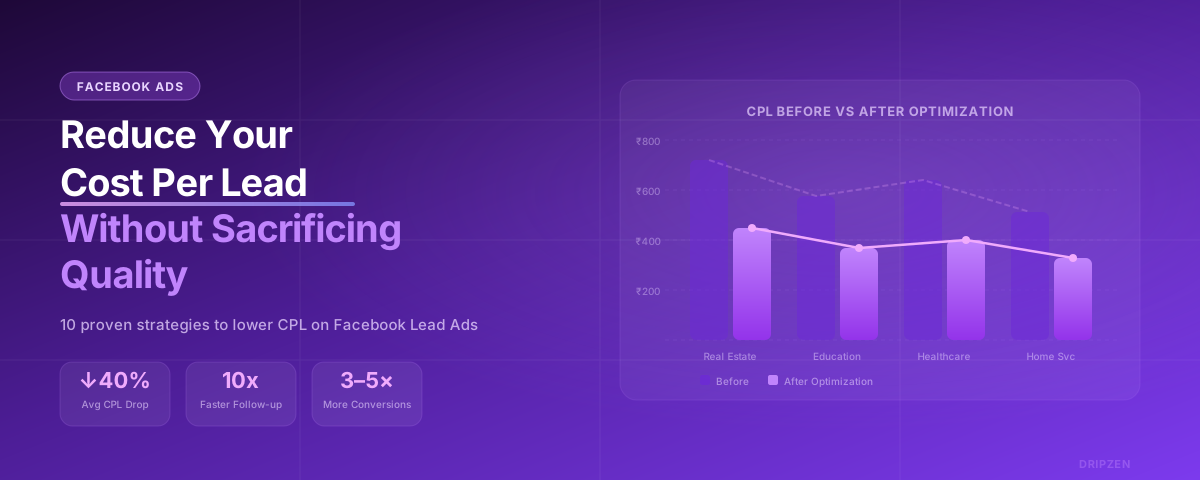
If you're running Facebook Lead Ads, you've probably asked this at least once: why is my cost per lead so high? Facebook CPL can range anywhere from ₹50 to ₹1,500+ depending on your industry, audience, and setup. And while it's tempting to slash budgets or target the broadest possible audience to bring costs down, that often backfires — you end up with cheaper leads that never convert.
The real goal isn't just a lower CPL. It's a lower CPL and leads that actually buy.
What Is Cost Per Lead (CPL) on Facebook?
Cost per lead (CPL) is the amount you spend on Facebook Ads divided by the number of leads generated.
CPL = Total Ad Spend ÷ Total Leads
For example: If you spent ₹10,000 and got 50 leads, your CPL is ₹200.
What's a Good CPL on Facebook?
CPL varies widely by industry. Here are rough benchmarks for India:
| Industry | Average CPL (India) |
|---|---|
| Real Estate | ₹300–₹800 |
| Education / Coaching | ₹100–₹400 |
| Insurance | ₹200–₹600 |
| Healthcare / Clinics | ₹150–₹500 |
| Home Services | ₹80–₹250 |
| Digital Marketing / B2B SaaS | ₹500–₹1,500 |
| E-commerce | ₹50–₹200 |
If your CPL is significantly above these ranges, the strategies below will help. If it's already low but leads aren't converting, skip ahead to the quality section.
Why Your Facebook CPL Is High
Before fixing CPL, understand the most common reasons it spikes:
- Broad or wrong audience — targeting too many people who don't actually want your offer
- Weak ad creative — low click-through rate means Facebook charges more per impression
- Long or complex lead form — friction drops completion rates, which inflates CPL
- Wrong campaign objective — using “Traffic” or “Awareness” when you should use “Lead Generation”
- No offer or unclear value — users won't fill a form if they don't know what they get
- Slow follow-up — leads go cold, conversion rate tanks, and Facebook's algorithm gets poor feedback signals
10 Strategies to Lower CPL on Facebook Without Losing Quality
1. Switch to the “Conversion Leads” Objective
This is the single biggest lever most advertisers miss. Facebook has two main lead ad objectives:
- Leads — optimizes for volume (lowest CPL, but inconsistent quality)
- Conversion Leads — optimizes for leads most likely to convert (slightly higher CPL, significantly better quality)
If you're sending leads to a CRM and have 50+ conversions tracked, switch to Conversion Leads. You connect your CRM to Meta via the Conversions API, and Facebook's algorithm learns which lead profiles actually close — then finds more people like them.
The result? You might pay 20–30% more per lead, but your close rate can double or triple, making the effective cost per sale much lower.
How to set it up:
- In Ads Manager, connect your CRM to Meta via Conversions API or a tool like Zapier
- Pass “qualified” or “won” status as conversion events
- Create a new campaign with the Conversion Leads objective
- Let it run until you have 50+ conversion events, then scale
2. Narrow Your Audience (Don't Go Too Broad)
Wide audiences feel efficient — more reach for the same budget. But they dilute your ad delivery to people unlikely to convert, raising CPL.
Test these targeting approaches:
- Custom Audiences: Upload your existing customer list. Facebook will find similar people through Lookalike Audiences.
- Lookalike Audiences (1–3%): The tightest match to your best customers. Start here before going broader.
- Interest + Behavioral Layering: Combine interests with behaviors and demographics to qualify the audience before they see your ad.
Don't target everyone in a country aged 18–65 with no interest filters. At small budgets, Facebook doesn't have enough data to self-optimize well — you need to guide it.
3. Write an Ad That Earns the Click
Your CPL is directly linked to your Click-Through Rate (CTR). A better ad = more clicks per impression = lower effective CPL.
High-converting Facebook Lead Ad formulas:
- Problem → Solution: “Losing track of your Facebook leads? DripZEN syncs every lead in real-time so you never miss a follow-up. Try it free.”
- Specific Outcome: “Real estate agents using this CRM close 40% more leads without hiring more staff.”
- Curiosity: “Most businesses respond to Facebook leads 8 hours too late. Here's how to fix it.”
What makes a strong ad creative:
- Native-looking visuals (not over-designed stock photos)
- A specific, believable outcome (not vague claims)
- A clear CTA button: “Get Started”, “Download”, “Sign Up Free” — not “Learn More”
- Video or GIF showing the product or process — these consistently outperform static images for lead gen
A/B test relentlessly. Even a 0.3% CTR improvement can drop your CPL by 20%+.
4. Shorten Your Lead Form — Ruthlessly
Every field you add to your lead form increases friction and drops completion rates. Lower completion = higher CPL.
The rule: Ask for the minimum information you need to qualify and follow up.
| What to Keep | What to Cut |
|---|---|
| ✓ Name | ✗ Address |
| ✓ Phone number | ✗ Company size |
| ✗ LinkedIn profile | |
| ✓ 1 qualifying question | ✗ Multiple dropdown questions |
Facebook auto-fills name, email, and phone from the user's profile. Short forms can be submitted in under 10 seconds.
Use “Higher Intent” form type. Facebook lets you choose between “More Volume” (pre-filled, one-tap submit) and “Higher Intent” (adds a review screen). Higher Intent forms reduce accidental submissions — CPL may rise slightly but quality improves. Test both.
5. Match Your Offer to Your Audience Temperature
Facebook is primarily a cold audience platform. Most people seeing your ad don't know you and aren't ready to buy. A lead form asking cold audiences to “Book a Sales Call” will have terrible CPL.
TOFU (cold) offers that lower CPL:
- Free guide / checklist / template — e.g., “Download: 10-Step Facebook Lead Follow-Up Checklist”
- Free trial or freemium app — “Try DripZEN free — no credit card required”
- Quiz or assessment — “What's your lead response time score?”
- Webinar or demo invitation — “Join our free live demo: Manage Facebook leads in 2 minutes”
The lower the commitment, the lower your CPL. Once someone is in your funnel, nurture them toward higher-commitment actions via email and retargeting.
6. Use Retargeting to Lower CPL on Warm Audiences
Warm audiences — people who've seen your ad, visited your website, or watched your video — convert at 3–5x higher rates than cold audiences. CPL from retargeting is often 40–60% lower.
Retargeting audiences to build:
- Website visitors (last 30, 60, 90 days)
- Video viewers (50%+ of a video ad)
- People who opened your lead form but didn't submit
- Instagram and Facebook page engagers
Key retargeting messages:
- Address the objection that stopped them: “Still on the fence? Here's what [similar business] said after week 1.”
- Create urgency: “Only 200 free spots left for early access.”
- Social proof: Testimonials, case studies, review screenshots.
Even a ₹3,000–5,000/month retargeting budget running alongside your main campaigns can dramatically lower your blended CPL.
7. Test Placements — Not Everything Works
By default, Meta runs ads across Facebook, Instagram, Messenger, and the Audience Network. Not all placements perform equally for lead generation.
What typically works best for lead forms:
- Facebook Feed
- Instagram Feed
- Facebook Stories
What often underperforms:
- Audience Network (third-party apps and websites)
- Messenger Inbox
- Marketplace (highly contextual — test carefully)
Run an initial broad placement test, then check CPL by placement in Ads Manager (Breakdown → Placement). Pause placements with CPL 2x above your average.
8. Schedule Ads for Peak Hours
Running ads 24/7 wastes budget during low-performing hours. For most B2B and service businesses, ads perform best on weekdays between 8 AM–12 PM and 5 PM–9 PM local time.
In Meta Ads Manager, use ad scheduling (available with lifetime budget campaigns) to restrict delivery to your highest-ROI hours. For many advertisers, this alone reduces CPL by 10–20%.
This requires testing your own data — use Ads Manager breakdown by “Time of Day” to see your actual peak performance windows.
9. Follow Up Within 5 Minutes — Seriously
This one isn't about your ads at all. But it dramatically affects your effective CPL because it changes how many leads actually convert.
Research consistently shows that responding to a lead within 5 minutes makes you 21x more likely to qualify them compared to waiting 30 minutes. After 1 hour, the lead has moved on.
Most businesses follow up within 24–48 hours. That means the majority of ad spend is partially wasted — not because the lead was bad, but because the follow-up was too slow.
What this has to do with CPL: If you convert 5% of leads into customers today and improve that to 10% by following up faster, your effective cost per customer acquisition drops by 50% — without spending a single extra rupee on ads.
The best way to follow up instantly is to have your Facebook leads auto-synced to a CRM that alerts you the moment a lead arrives. Apps like DripZEN sync Facebook Lead Ads in real-time, send push notifications the instant a lead submits, and give you a full pipeline to track who's been contacted, qualified, and won.
When leads don't go cold, your ad spend works harder.
10. Optimize the Landing Page (If You're Using One)
If you're using an external landing page instead of Facebook's native lead form, your landing page conversion rate directly determines your CPL.
A page converting at 5% gives you a CPL of ₹1,000 at ₹50/click. Improve conversion to 10% and CPL drops to ₹500 — same ad spend, same traffic.
Landing page CPL reducers:
- Headline matches the ad copy exactly (message match)
- Clear, specific value proposition above the fold
- Single CTA — no navigation menu, no competing links
- Social proof: logos, numbers, testimonials
- Mobile-optimized (80%+ of Facebook traffic is mobile)
- Fast load time (under 3 seconds)
The CPL vs. Lead Quality Trap
Here's the mistake most advertisers make: they optimize only for CPL. They broaden audiences, shorten forms aggressively, use “More Volume” form type, and offer a zero-barrier lead magnet. CPL drops from ₹500 to ₹150. Success?
Not if 90% of those leads are unqualified.
The metric that matters is cost per qualified lead or cost per customer acquisition (CAC) — not raw CPL.
A ₹500 CPL with a 20% close rate is far better than a ₹150 CPL with a 2% close rate.
How to track lead quality:
- Add a CRM to your workflow and tag leads as Qualified / Unqualified / Won
- Connect CRM outcomes back to Meta via the Conversions API
- Let Facebook optimize for leads that actually convert, not just any lead
This is the core idea behind Conversion Leads optimization (Strategy #1 above) — and it's why managing your leads properly isn't just an operational task, it's a performance marketing lever.
Quick-Win Checklist: Lower CPL This Week
- Switch campaign objective to Conversion Leads (if you have 50+ tracked conversions)
- Remove all but essential fields from your lead form
- Add one qualifying question to filter intent
- Create a 1–3% Lookalike Audience from your best customers
- Launch a retargeting campaign for website visitors and video viewers
- Set up real-time lead alerts so you follow up within 5 minutes
- A/B test two ad creatives — one video, one image
- Check placement breakdown and pause underperforming placements
- Review your lead form type (More Volume vs. Higher Intent)
- Ensure your landing page (if used) loads in under 3 seconds
Close More Leads — Without Spending More on Ads
Lower CPL only works if the leads you generate actually become customers. DripZEN ensures no lead goes cold — syncing Facebook Lead Ads in real-time, alerting your team the moment a lead arrives, and giving you a full pipeline to track every opportunity.
- Real-time lead sync — no manual CSV exports, no missed leads
- Instant push notifications — follow up before competitors do
- Visual pipeline — New → Contacted → Qualified → Won
- Team assignment — clear ownership, zero confusion
- Message templates — respond faster, stay consistent
- Mobile-first — manage leads from anywhere
Final Thoughts
Reducing CPL on Facebook Ads is not about finding a magic audience or a secret creative format. It's about systematically removing friction at every stage: targeting, creative, form, and follow-up.
The businesses that win at Facebook Lead Ads aren't necessarily the ones with the biggest budgets — they're the ones who move fastest, optimize relentlessly, and never let a lead go cold.
Start with the highest-impact changes (Conversion Leads objective, shorter form, faster follow-up), track your numbers weekly, and iterate. And once those leads start coming in, make sure you have a system to manage them. Because a lower CPL only helps if those leads actually become customers.
Frequently Asked Questions
What is a good cost per lead on Facebook Ads in India?
CPL varies by industry. Real estate averages ₹300–₹800, education ₹100–₹400, healthcare ₹150–₹500, and home services ₹80–₹250. If your CPL is significantly above these ranges, focus on audience targeting, ad creative, and form optimization.
How do I reduce my Facebook Ads CPL fast?
The fastest wins: switch to Conversion Leads objective, shorten your lead form to 3–4 fields, create a 1–3% Lookalike Audience from your best customers, and A/B test your ad creative. These changes can reduce CPL within 7–14 days.
Does lowering CPL hurt lead quality?
It can if done incorrectly. Broadening your audience too wide or removing all qualifying questions lowers CPL but floods you with unqualified leads. The right approach is to optimize for cost per qualified lead or cost per customer acquisition, not raw CPL.