
The True Cost of a Lost Lead (And How to Stop Losing Them)
TL;DR — Key Takeaways:
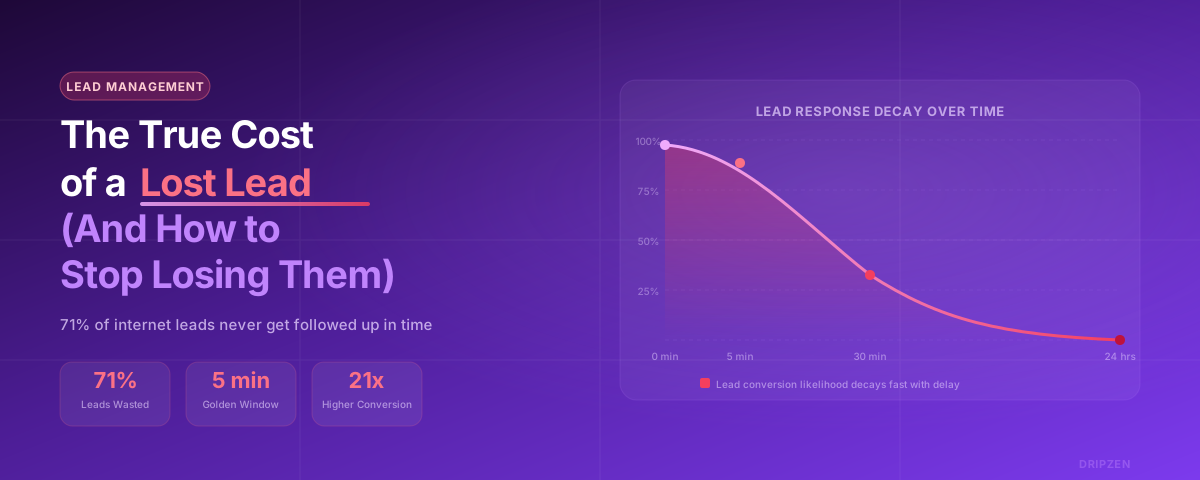
- 78% of customers buy from the first business that responds to their inquiry. Second place often gets nothing.
- Leads are 100x less likely to be contacted if you wait 30 minutes instead of 5.
- Companies responding within 5 minutes generate 9x more conversions than those who wait.
- 71% of internet leads are wasted due to poor follow-up.
- Fixing speed-to-lead with automation can pay for itself in under 90 days for businesses with 100+ monthly leads.
Introduction: The Leak You Can't See
What if thousands of dollars of your marketing budget were quietly vanishing every month? Not because your ads were broken. Not because your offer was weak. But because the leads you paid for were never followed up with fast enough — or at all.
The cost of lost lead is one of the most expensive, most invisible problems in modern business. Every day, small business owners, marketers, and entrepreneurs pour money into Facebook ads, Google campaigns, and lead magnets — only to watch those leads go cold before a single conversation happens. The lead follow up cost of doing things manually (or not doing them at all) is staggering. In this post, we'll break down exactly how much does a lost lead cost, why leads decay faster than you think, and what you can do to stop the bleeding today.
Whether you run Facebook ads, Google PPC, or any digital lead generation, the numbers below will change how you think about follow-up forever.
The Shocking Reality: What Happens to Most Leads
Here's a truth most businesses don't want to face: the majority of leads you generate will never turn into a conversation — let alone a customer.
If you generate 100 leads this month, roughly 70 to 80 of them will never turn into revenue — not because they weren't interested, but because your follow-up process didn't catch them at the right moment.
And the problem isn't just that leads go unanswered. It's that they go unanswered fast.
In a landmark study by Dr. James Oldroyd at MIT Sloan, researchers found that the odds of contacting a lead drop 100 times when comparing a 5-minute response to a 30-minute response. The odds of actually qualifying that lead drop 21 times in the same window. Not 21%. Not 2x. 21 times.
A follow-up study published in Harvard Business Review confirmed the damage: firms that contacted prospects within one hour were nearly 7 times more likely to qualify the lead than those that waited just one hour longer — and more than 60 times more likely than companies that waited 24 hours or more.
Yet despite this overwhelming evidence, the average first response time among companies that actually responded was 42 hours — and 23% of companies never responded at all.
The problem isn't a lack of interest from buyers. It's a speed-to-lead gap most businesses don't even know they have.
The Math: Calculating What a Lost Lead Actually Costs
If you run Facebook ads, Google Ads, or any paid lead generation, you already know that leads aren't free. But the true lost lead revenue goes far deeper than your cost-per-click.
What You're Paying Per Lead
Here's what a lead costs by industry, on average:
| Industry | Average Cost Per Lead (CPL) |
|---|---|
| B2B SaaS | $237 |
| Real Estate | $448 |
| Manufacturing | $553 |
| Legal Services | $649 |
| Financial Services | $653 |
| Higher Education | $982 |
Source: FirstPageSage 2026 Report
Customer acquisition costs have risen ~60% over the past five years. That means the leads you're generating today are more expensive than ever — and losing them hurts more than it ever has.
The Lost Lead Revenue Formula
Let's say you're a B2B company generating 500 leads per month with an average deal value of $5,000.
Respond under 5 min
- ~21% qualification rate
- 105 qualified leads
- $525,000 in pipeline
Respond in 1 hour
- ~1.5% qualification rate
- 8 qualified leads
- $40,000 in pipeline
Monthly lost pipeline from slow response: $485,000.
Annual lost pipeline: $5,820,000.
That's not a typo. Nearly six million dollars in pipeline evaporates because of response time alone.
Or consider a home services company (HVAC/plumbing) doing 127 monthly estimates. Their converted estimates bring in $1,088,000/year — but their unconverted estimates represent $2,112,000 in lost revenue. Every unconverted HVAC estimate costs $8,400. Every unconverted plumbing estimate costs $2,100.
The math is brutal and simple: every lead you don't follow up with fast enough is a direct hit to your bottom line.
The Marketing Waste Multiplier
If your company spends $100,000 on lead generation and 70% of leads are never contacted due to slow or nonexistent follow-up, $70,000 of that budget is effectively wasted.
You've already paid for the lead. You just didn't collect the return.
Why Leads Go Cold (Before You Even Call)
Leads don't sit patiently waiting for your call. They behave like matches — they flare with interest, then burn out.
The 5-Minute Decay Window
Lead quality drops 80% after the first 5 minutes. That means by the time you finish your coffee, the lead's interest has already cratered. Every 10-minute delay decreases conversion chances by 400%. After just 30 minutes, leads are already slipping through your fingers.
Here's what the data looks like:
| Response Time | Qualification Rate | Conversion Impact |
|---|---|---|
| Under 5 minutes | 21% | 9x more conversions |
| 5–30 minutes | 9% | −57% |
| 30–60 minutes | 4% | −81% |
| 1–24 hours | 1.5% | −93% |
Source: InsideSales.com / Greetnow aggregate data
Why Humans Behave This Way
When a prospect fills out a form, clicks an ad, or requests a quote, they are at peak intent. Their attention is on your business. Their problem is top of mind. But human attention is fleeting. Within minutes, a notification pulls them away, a coworker interrupts, or they open a competitor's site while waiting for your response. By the time you call three hours later, they've moved on. The emotional urgency that drove their action has faded — and you're now just another cold call.
The Competitor Factor
Here's the hardest pill to swallow: 78% of customers buy from the first business that responds to their inquiry. Second place often gets nothing.
If your competitor responds in 2 minutes and you respond in 2 hours, guess who wins the customer? In real estate, legal services, home services, and automotive, the first responder captures the vast majority of the business. It's not about being the best. It's about being first.
And if you're running Facebook ads, you're competing in a feed where attention is the scarcest resource. If you don't follow up while your brand is still in their mind, someone else will.
The Hidden Cost: Brand Reputation and Opportunity
The cost of lost lead isn't just about the immediate revenue. The damage ripples outward in ways that compound over time.
Lost Lifetime Value (LTV)
A healthy customer lifetime value to acquisition cost ratio (LTV:CAC) is 3:1. But the average across industries is actually 1:4 — meaning most businesses are spending more to acquire customers than those customers are worth.
When you lose a lead, you don't just lose one sale. You lose repeat purchases, referrals, upsells, and brand advocacy over the entire relationship. For a SaaS business, losing one lead that would have been a $500/month customer for 3 years is an $18,000 loss. For a home services business, losing one HVAC estimate is an $8,400 loss — and that's before referrals.
Market Share Erosion
Every lead your competitor converts is a customer you didn't win. In competitive markets, the business with the fastest follow-up systematically gains market share while slower competitors shrink. This is especially brutal in:
Misaligned sales and marketing teams — teams that generate leads but don't follow up on them effectively — lose up to $1 trillion annually in wasted spend and inefficiencies. Nearly 80% of marketing leads go unconverted due to lack of coordination between teams.
Your lead problem isn't just your problem. It's an industry-wide epidemic.
How to Stop Losing Leads: The DripZEN Framework
The cost of lost lead is a solvable problem. The businesses that fix their follow-up speed see dramatic results — often within weeks, not months.
Here are the five pillars of a modern lead follow-up system:
The 5-Minute Response Rule
Respond within 5 minutes, or don't bother. Companies responding within 5 minutes generate 9x more conversions. Calling within 1 minute increases conversions by 391% vs. waiting 2 minutes.
Automate the First Touch
Manual follow-up is impossible at scale. DripZEN connects to your Facebook lead ads and triggers multi-channel follow-up — SMS, email, CRM notifications — within seconds of submission.
Multi-Touch Follow-Up (The 6-Touch Rule)
93% of converted leads are reached by the 6th call attempt. Yet 48% of salespeople never follow up at all. A real system requires 6–8 touchpoints over 7–10 days.
CRM Integration and Lead Scoring
Track every touchpoint, score leads based on behavior, and route hot leads to your best closers instantly — not all leads are equal.
Measure What Matters
Track response time, contact rate, qualification rate, and cost per qualified lead. Automation delivers 20–30% more qualified opportunities within 6 months.
Conclusion: The Real Cost Is Inaction
The cost of lost lead is not theoretical. It's a measurable, addressable crisis costing businesses millions in wasted ad spend and missed opportunities every year.
If you're spending money on Facebook ads or any lead generation, you owe it to yourself to capture the full value of every lead you pay for. The difference between a business that thrives and one that struggles often comes down to one thing: how fast they follow up.
The businesses that win in 2026 and beyond won't be the ones with the biggest ad budgets. They'll be the ones with the fastest, most reliable, most automated follow-up systems. They'll be the ones who never let a lead go cold.
Stop Losing Leads — Respond in Seconds, Not Hours
DripZEN connects directly to your Facebook Lead Ads and automatically triggers multi-channel follow-up — SMS, email, and CRM notifications — within seconds of a lead submitting their information. No manual data entry. No leads sitting in a spreadsheet.
- Real-time lead sync — no manual CSV exports, no missed leads
- Instant push notifications — follow up before competitors do
- Automated multi-touch sequences — 6–8 touchpoints, fully automated
- Visual pipeline — New → Contacted → Qualified → Won
- Team assignment — clear ownership, zero confusion
- Mobile-first — manage leads from anywhere
Frequently Asked Questions
How much does a lost lead actually cost?
Beyond the cost-per-lead (CPL), a lost lead costs you the full customer lifetime value. For a B2B company with a $5,000 deal size, slow response alone can drop monthly pipeline from $525,000 to $40,000 — a loss of $485,000 per month.
What is the 5-minute lead response rule?
Research by MIT Sloan and InsideSales.com found that responding to a lead within 5 minutes generates 9x more conversions than responding after 5 minutes. Waiting 30 minutes drops contact odds by 100x.
Why do leads go cold so fast?
When a prospect fills out a form, they are at peak intent. Within minutes, competitors respond, attention shifts, and emotional urgency fades. Lead quality drops 80% after the first 5 minutes.
How many follow-up attempts does it take to convert a lead?
93% of converted leads are reached by the 6th call attempt. Yet 48% of salespeople never follow up at all, and 44% quit after one attempt. A minimum of 6–8 touchpoints across 7–10 days is required for consistent conversion.
Sources
- Dr. James Oldroyd, MIT Sloan / InsideSales.com — Lead Response Management Study (2007). "78% of customers buy from the first business to respond."
- Dr. James Oldroyd, MIT Sloan — "The odds of contacting a lead if called in 5 minutes versus 30 minutes drop 100 times. The odds of qualifying a lead drop 21 times."
- InsideSales.com / Greetnow aggregate data. "Companies responding within 5 minutes generate 9x more conversions."
- Verse.ai / Forbes, as cited in LeadResponse.co (2026). "Nearly three-quarters of all internet leads are wasted."
- Gartner / Forrester, as cited in Greetnow (2025). "20–30% increases in qualified opportunities within 6 months. Payback period typically under 90 days."
- Salesforce / MarketingSherpa. "About 79% of leads never convert into sales."
- Kixie / RevenueHero / InsideSales.com. "Approximately 30% of leads are never contacted by the businesses that generated them."
- Salesforce / Teamgate / Kixie. "Only about 27% of leads are ever contacted."
- Drift Lead Response Report (2017). "55% of companies take more than 5 days to respond to leads."
- Oldroyd, J., McElheran, K., & Elkington, D. — Harvard Business Review (March 2011). "Firms contacting prospects within one hour were nearly 7x more likely to qualify the lead."
- FirstPageSage — Average Cost Per Lead by Industry (December 2025).
- Paddle, as cited in Martal.ca (May 2026). "Customer acquisition costs have risen ~60% over the past five years."
- US Tech Automations / Angi 2025 State of Home Services / ServiceTitan (March 2026).
- InsideSales.com / Lead Response Management Study. "Every 10-minute delay lowers conversion chances by 400%."
- HubSpot / SaaS Capital / Forrester / CleverTap (March 2026). "A 3:1 LTV:CAC ratio is considered healthy."
- Velocify 2023 Real Estate Lead Response Report. "Sub-60-second response improves closing rate 3x."
- Numa — Dealership Unconverted Lead Revenue (2025–2026). "$5.3 million annually in lost service revenue."
- LocaliQ / LegalBrandMarketing / Majux. "Improve conversion to 30% and cost per client drops 53%."
- LinkedIn / Forrester / MarketingProfs. "Misaligned teams lose up to $1 trillion annually."
- Velocify — The Ultimate Contact Strategy. "Responding within the first minute increases lead conversions by 391%. 93% of converted leads reached by 6th call."
- 2x Solutions AI / industry surveys (March 2025). "48% of salespeople never follow up. 44% quit after one attempt."
- Velocify Contact Strategy Research. "50% of sales leads are never contacted a second time."